TL;DR
The short version: there are two kinds of “cable rail,” and they’re not the same product — the gap shows up in looks, cost, and how long it lasts.
- Kit cable rail — pre-made, off-the-shelf, sold as DIY. Cheaper and faster, but standardized (built to fit itself first, your space second), surface-mounted only, with bigger posts and quality that varies a lot.
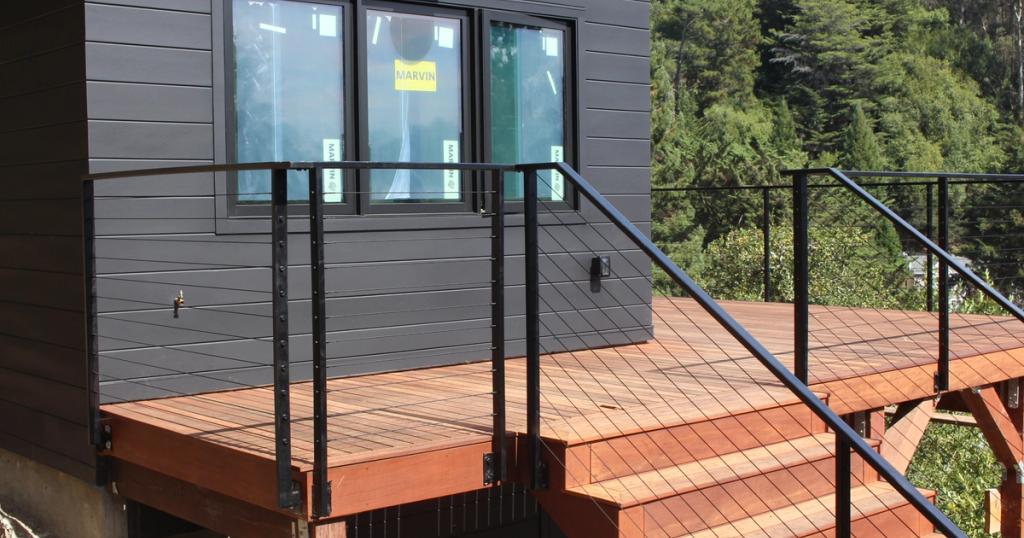
- Custom cable rail — cut and welded to your exact space. We use 2"×1" 11-gauge steel posts + top rail (rigid, no hollow feel), hidden hardware, and mounting a kit can’t do — including hidden fascia mounting.
- Kits struggle with stairs, angles, uneven surfaces, and long spans — and a DIY install can quietly cost more than you planned.
- Rule of thumb: a kit’s a fine call for a short, straight, level deck run on a budget. Custom earns its cost on stairs, angles, long views, and anywhere you want it to look right and last.
Not all cable rail is made equal.
Cable rail is our most requested style of railing. It seemingly disappears into the view, reads clean and modern, and can be used for guardrails and handrails alike. But when someone says they want “cable rail,” they could mean one of two very different products, and the difference shows up in how it looks, how long it lasts, and what it costs.
What is kit cable rail?
A kit is a pre-manufactured cable railing system. The posts, cable, and tensioning hardware are all off-the-shelf. They are usually made of aluminum, stainless steel, wood, or composite. Frequently marketed as a “ready to be assembled” (Lego-esque system), that can be built on-site by a homeowner.
The reality:
Ready to be assembled, and easy to assemble are two different stories. Could you assemble and install this? Yeah, it’s not like you’re being asked to paint the Sistine Chapel. But you are being asked to build something.
- How much experience do you have with that?
- Are you comfortable with having that safety in your hands?
- Do you have the tools?
- Do you have the time?
What can end up happening is that you try to install this yourself and you don’t feel confident, you’re missing a tool, it takes more time than anticipated, you install it incorrectly (strip a screw or bore-out a hole) and need to start from scratch, put holes in your deck you can’t fix, and end up paying a contractor to install it, potentially costing you thousands of dollars more than you anticipated.
Everything is standardized: fixed post heights and dimensions, standard spacing, surface-mounted brackets with holes drilled at set distances for their hardware. That’s the pitch. It's cheaper upfront, quick to source, and DIY-friendly. If you have a short, straight, level run and a tight budget, a kit can get the job done.
The downsides:
Standardized fits standardized. Kit cable rail is like IKEA - it’s designed to work with itself first, and your space second. Kits use bigger (not thicker) posts, exactly what you don’t want when the goal is an unobstructed view.
Fixed heights help hit code, but kits pull it off by surface-mounting; which raises its own questions:
- Do the mounting bracket holes align with your joists?
- Do you need blocking?
- Are you okay with your railing encroaching on your deck space?
- Is your deck standardized?
Straight and level is ideal, but not always a reality. To be fair, your deck doesn’t need to be perfect to be suitable for kit cable rail, but odd angles, stairs, out-of-level surfaces, and long spans are where kits struggle. Trying to work around these unforeseen problems means time, energy, and money out of your pocket.
Not all kits are made equal. Kits (in general) tend to use larger posts, but this is not always synonymous with the wall thickness. Depending on the kit cable railing system you get, and the company you go with, you can get a wide variety of quality. The high-end kit cable rail companies offer a quality kit, but in exchange for a higher price, and a more complex installation process (essentially pigeonholing you into their partnered installers). The cheaper kit cable railing systems on the market come at the cost of quality. Lower quality means even less adaptability to your environment, and cheaper materials, which are either not suitable for their intended purpose, or bulkier. The opposite of what you’d want when the goal is an unobstructed view.
What is custom cable rail?
Custom cable rail is fabricated to your project. Designed in your image, cut and welded to your exact dimensions, angles, and mounting conditions.
How we differ:
We offer a wide range of materials including: steel, stainless steel, aluminum, brass, and bronze; and the ability to powder coat any color you want.
Where kit railing companies and other custom railing fabricators opt for using bulky posts, we diverge. We offer 2”x1” (11 gauge) steel posts (for a strong base, sleek look, and open view) welded to a 2”x1” 11 gauge steel top rail. This combination resists sag and deflection, and gives you a rigid railing with a presence you can feel, avoiding the common hollow feeling associated with kit cable rails. (More on why top-rail thickness matters in [our “What Is a Railing?” guide].)
Hidden hardware and clean terminations. We integrate the tensioning and fittings so the rail reads as pure lines, not bolts and brackets. Offering specialized solutions to hide hardware where it matters and a wide variety of mounting options.
Kit cable railing only offers surface-mounting. We work around your environment with mounting done right. Offering a wider range of mounting techniques including: deck fascia mounting, wall mounting, and our unique process of hidden fascia mounting.
We can adjust and build anywhere. Stairs, angled runs, curves, hillside geometry, tricky mounting; not a problem. We 3D-scan and render the site, scribe to uneven surfaces, and use relative leveling so the rail follows your space exactly.
A kit can’t do that.
(For more on our [process])
But do you need custom? The honest answer.
Not always. If you’ve got a straight, level, standard-height deck run, you’re doing the work yourself, and budget is the priority, a kit is a legitimate choice.
Custom earns its cost when:
You have stairs, angles, curves, or long spans.
The view is the point and you don’t want it chopped up by posts and hardware.
You want it to look right and stay tight for the long haul, not need re-tensioning.
The railing is a visible, permanent part of a home you care about.
One takeaway question is:
Do you really want to ruin your expensive, gorgeous deck (and interrupt your view) by skimping on a kit cable rail?
Bottom line
Kit cable rail is a commodity: fast, cheap, and fine for simple jobs. Custom cable rail is a tailored piece of metalwork: stronger, cleaner, built for your exact space, and made to last. If you want the minimalist cable look to actually look minimalist (and hold up) custom is what gets you there.